
Manufacturing Training Under Fire: Navigating the ‘Big Beautiful Bill’ Challenge

Imagine running a manufacturing training department and finding out that everything you thought you knew about compliance just changed overnight. That’s exactly what happened when H.R. 1, the “One Big Beautiful Bill Act,” became law on July 4, 2025.
Manufacturing Training with The Big Beautiful Bill
This new law has created massive problems and huge opportunities at the same time. Training departments are now facing tight deadlines and complex new rules while trying to capture millions in tax savings. The companies that acted fast in the first month since enactment are already winning big. Those that haven’t yet adapted risk costly mistakes and missed chances.
Here’s the bottom line: Your training department needs to change how it works, and the window for action is closing fast.
What the “Big Beautiful Bill” Means for Training Departments
The “Big Beautiful Bill” completely rewrote the rules for manufacturing companies. It gives huge tax breaks to traditional manufacturers while making life much harder for clean energy companies.
The biggest challenge? New foreign supplier rules that take full effect January 1, 2026 [(Congress.gov – H.R. 1 Official Text)]. Companies must now check every supplier to make sure they’re not on the banned list. Get it wrong, and you could face penalties worth 20% of your tax savings.
But there’s good news too. The law brings back 100% bonus depreciation and lets companies immediately write off R&D costs [(Plante Moran)]. For companies that train their teams right, this could mean millions in tax savings.
Training departments are now caught in the middle of this massive change. They need to teach teams about complex new rules while helping them grab these new tax benefits. And they have to do it all under very tight deadlines.
The Compliance Training Challenge That’s Keeping Everyone Up at Night
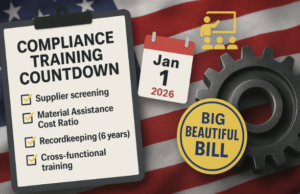
Manufacturing training departments report being overwhelmed by the new supplier rules. The law requires companies to screen suppliers against banned foreign company lists. Companies must track complex calculations called Material Assistance Cost Ratios [(Hogan Lovells)].
Here’s how complex it gets:
- 40% domestic content required in 2026, rising to 60% after 2029
- Solar components need 50% in 2026, climbing to 85% after 2029
- All records must be kept for six years
- Supplier forms must be signed under penalty of perjury
Training departments now need to teach multiple departments at once. Legal teams need to learn the new banned company rules. Purchasing teams need to know how to check suppliers. Finance teams need to master complex tax calculations.
One training manager told us: “We used to focus on safety and basic compliance. Now we’re teaching international trade law to people who just want to buy raw materials.”
The timeline makes everything more urgent. Key deadlines that companies are now working toward include:
- July 4, 2025: Enhanced restrictions began (now in effect)
- December 31, 2025: Material assistance rules start (less than 5 months away)
- July 4, 2026: Final deadline for certain projects
Most traditional training programs take 6-12 months to develop. Companies that haven’t started yet are already behind schedule.
For more guidance on managing complex compliance requirements, check out our [manufacturing compliance best practices] resource center.
Tax Benefits Training: The Million-Dollar Opportunity
While compliance creates headaches, the tax benefits create huge opportunities. Companies that train their teams right are already saving millions in taxes [(KBKG)].
100% Bonus Depreciation Is Back The law restored full depreciation for equipment bought after January 19, 2025. This means companies can write off the full cost of new machines in the first year instead of spreading it over many years.
New Factory Write-Offs The Qualified Production Property rule lets companies immediately write off new manufacturing buildings. But there are strict rules about what counts and how long companies have to build.
R&D Costs Are Deductible Again Companies can now immediately deduct research and development costs instead of spreading them over five years. Small companies under $31 million in sales can even file for refunds on past R&D costs.
Government Training Money Is Still Available Despite budget cuts, significant funding remains:
- H-1B skills training grants: Up to $150 million available [(Department of Labor)]
- Defense manufacturing programs: $3.3 billion allocated [(Congress.gov)]
- Advanced manufacturing grants: $425 million still available
The key is training finance teams to understand these rules and maximize the benefits. Companies report that proper training on tax benefits often pays for itself within months.
More Related Articles
- Supercharging U.S. Manufacturing: 5 Key Ways Trump’s “The Big Beautiful Bill” (OBBBA) Impacts U.S. Manufacturing
- How 100% Bonus Depreciation Supercharges U.S. Manufacturing Under the OBBBA
- Unlock Free Cash: Top Manufacturing Grants You Can’t Ignore in 2025
- Workforce Development Grants and Funding for Manufacturers
- Don’t Just Onboard—Build Capacity: The Process-Based Approach to Resilience and Results in Manufacturing
- Manufacturing Leadership That Transforms: Building True Followership
Technology Training Gets More Complex
The new law has forced major upgrades to computer systems. Companies need software that can track suppliers in real-time and calculate complex ratios automatically [(NetSuite)].
ERP System Upgrades Are Essential Most current systems can’t handle the new requirements. Companies need:
- Real-time supplier tracking
- Automatic compliance checking
- Six-year record keeping
- Penalty calculation systems
Supply Chain Visibility Platforms Companies need new tools to see their entire supply chain [(Supply Chain Digital)]. These platforms use advanced technology to track materials from source to final product.
Cross-Functional System Training The new systems connect purchasing, warehouse, finance, and legal departments. Training teams need to understand how all these pieces work together.
This has created a massive retraining challenge. Teams that used simple systems now need to learn complex software platforms. The learning curve is steep, and companies are scrambling to get people trained before the January 2026 deadline.
Our [manufacturing technology training] section offers practical guidance for managing these transitions.
MEP Program Elimination Created Training Gaps
One of the biggest challenges facing training departments is the loss of Manufacturing Extension Partnership (MEP) programs. These programs were eliminated just when companies needed help most [(Industry Week)]
What Companies Lost:
- 1,400 trusted advisors at 430+ locations
- Technology assessment services
- Workforce development programs
- Connections to universities and research labs
Ten states have already lost MEP funding [(Advanced Manufacturing)]. The remaining programs face cuts as contracts expire through 2026.
This has created immediate problems for smaller manufacturers who relied on MEP for training and technical support. Companies now need to find alternative sources for help with technology upgrades and workforce development.
Smart Training Departments Are Adapting Fast
The most successful training departments have made major changes to how they work in the past month. They’re using accelerated training models that cut development time by 50-75% [(NIST)].
Accelerated Training Approaches:
- Boot camp-style programs that finish in 3-4 months
- Micro-learning modules that take 5-10 minutes
- Mobile apps for just-in-time training
- VR and AR systems that reduce training time by 50-60%
New Partnership Strategies: Smart departments are building new relationships to replace lost MEP services:
- Direct partnerships with community colleges
- Shared training consortiums with other manufacturers
- Private consulting relationships
- Digital learning platform subscriptions
Cross-Functional Training Teams: The most effective departments now coordinate training across multiple functions. They bring together legal, finance, purchasing, and operations teams for integrated training programs.
Companies using these approaches report much faster results. Instead of taking a year to develop new programs, they’re launching in 2-3 months.
Timeline Pressure Demands Smart Choices
Training departments face extreme time pressure. The most critical deadlines are just months away [(McDermott Will & Emery)].
Priority-Based Resource Allocation: Smart departments use simple frameworks to decide what to train first:
- Immediate and Important: Supplier compliance rules (do first)
- Important but Not Immediate: Advanced tax strategies (do second)
- Immediate but Not Important: Basic system updates (delegate)
- Neither: Nice-to-have training (skip for now)
Just-in-Time Training Models: Instead of comprehensive programs, departments are focusing on specific skills needed right now:
- QR codes for instant procedure access
- Mobile-friendly micro-lessons
- Performance support tools built into work processes
- Competency-based assessment (prove skills, not classroom hours)
Resource Optimization:
- 70% budget for proven training methods
- 20% for emerging approaches
- 10% for experimental programs
The key is focusing on what will have the biggest impact in the shortest time.
For comprehensive strategies on managing training priorities under pressure, visit our [manufacturing training management] resource hub.
Technology Investments Enable Scale
Cloud-based learning platforms have become essential [(TalentLMS)]. These systems allow rapid updates and can be accessed from anywhere.
Key Technology Capabilities:
- Mobile learning for 24/7 access
- Real-time progress tracking
- Automatic compliance reporting
- Integration with existing systems
Advanced Training Technology:
- AI-powered content recommendations
- Virtual reality for equipment training
- Blockchain for training record security
- Analytics to predict training needs
The best systems combine compliance tracking with skills development. They help companies meet legal requirements while building actual capabilities.
What This Means for Your Training Department
The “Big Beautiful Bill” represents the biggest change in manufacturing training requirements in decades. Training departments that adapt quickly are helping their companies save millions and avoid costly penalties. Those that don’t are struggling with compliance problems and missed opportunities.
Immediate Actions for Training Leaders:
- Assess your current capabilities against new requirements
- Identify critical skills gaps in compliance and tax optimization
- Develop accelerated training programs for priority areas
- Build new partnerships to replace MEP services
- Invest in technology platforms that support rapid deployment
Resource Allocation Recommendations:
- 40% of budget for compliance training
- 30% for tax benefit optimization
- 20% for technology system training
- 10% for strategic skill development
Timeline Management:
- Address August-December 2025 priorities first
- Build January 2026 capabilities second
- Plan for 2026+ requirements third
The companies that succeed will be those that treat this challenge as an opportunity to build better training capabilities while capturing significant financial benefits.
The Bottom Line
The “Big Beautiful Bill” has forced manufacturing training departments to completely rethink how they work. The challenge is real, but so is the opportunity. Companies that invest in accelerated training programs, build new partnerships, and leverage technology platforms will emerge stronger and more profitable.
The timeline is tight, the requirements are complex, and the stakes are high. But training departments that act fast and smart are helping their companies not just survive this transition, but thrive in the new landscape.
The transformation is happening whether you’re ready or not. The question is: Will your training department lead the change or get left behind?
References:
- [Congress.gov – H.R. 1 Official Text]
- [Plante Moran – 100% Bonus Depreciation Returns]
- [Hogan Lovells – FEOC Restrictions Analysis]
- [KBKG – One Big Beautiful Bill Tax Changes]
- [Department of Labor – H-1B Skills Training Grants]
- [NetSuite – ERP Compliance Tips]
- [Supply Chain Digital – Traceability Platforms]
- [Industry Week – MEP Funding Uncertainty]
- [Advanced Manufacturing – MEP Funding Cuts]
- [NIST – MEP Workforce Programs]
- [McDermott Will & Emery – Clean Energy Tax Credits]
- [TalentLMS – Compliance Training Software]
- [Tax Foundation – OBBB Analysis]