


Why This Matters Now for Manufacturers
If you run a processing plant, you’re feeling the pressure: labor shortages, supply chain unpredictability, shifting regulatory requirements, a retiring workforce, the rapid pace of change and workforce skill gaps. These challenges aren’t unique to your operation—they’re everywhere. But the best plants don’t just react to change. They prepare for it. Process-based onboarding is critical for manufacturing plants facing labor shortages, skill gaps, and operational pressures.
Here’s the reality:
- 37% turnover rate in manufacturing costing $3,500–$12,000 per worker (~Talent Rewire, 2024)
- 46% of midsized companies can’t find skilled workers (~National Center for the Middle Market & Brookings Report, 2017)
- 2.1 million jobs unfilled by 2030 due to skills gap (~Deloitte & The Manufacturing Institute, 2021)
- Many companies don’t have capacity to solve the root causes, leadership burnout, or culture chaos.
In a rapidly changing manufacturing marketplace, you can’t afford a revolving door.
Effective onboarding— from the shop floor through top leadership— is a strategic lever and simple starting point for:
- Operational stability
- Employee and skills retention
- Succession planning
- Cross-departmental coordination and innovation
- Culture that drives results
Yesterday’s Problems, Today’s Urgency for Manufacturers
I’ve been helping midsized factories develop workforce and leadership capabilities since the 1990s. The pressures today feel familiar—but more intense.
Back then, manufacturers, eg; food processing plants were racing to meet stricter regulatory standards in response to foodborne illness outbreaks. Scientific advances were raising the bar for microbiological controls, and globalization required consistent quality across borders. Manufacturers and their plants had to stretch limited capacity and resources to stay competitive—and compliant.
Today, plants still operate lean—but now under the strain of rotating talent, minimal time for skill-building, and fragile leadership pipelines. Post-pandemic, many organizations have deferred investment in workforce development, team learning, and cross-functional leadership. The result? A fragile system increasingly vulnerable to disruption.
We Have the Tools—We’re Just Not Using Them
The good news: We don’t have to invent new solutions. We already have proven methods to navigate this narrowing wormhole of capacity.
- People intelligence: human-centered design, behavioral change science, and evidence-based relationship skills
- Operational toolkits: lean manufacturing, Toyota Production System principles, and TWI-style structured training
Yet too often, no one in-house is tasked with stitching these pieces together across departments. Training becomes fragmented—or worse, performative. Culture efforts remain stuck at the surface.
As the Brookings report makes clear:
“Close to half (44%) of middle market companies say that a lack of necessary skills among candidates is a top reason it is difficult to recruit. What’s more, 37%… say that their companies’ ability to grow is constrained by a lack of talent.”
In other words, talent gaps aren’t just a workforce problem—they’re a growth constraint. And too often, they’re made worse by a missing link: someone with the visibility, skill, and authority to develop people across functional areas – a call for process-based onboarding.
Culture and Clarity: What Training Alone Can’t Fix
Training helps create culture—but it can also be blocked by it. In organizations without cohesive norms and processes, even great training won’t stick.
Effective cultures foster what I call “straight-talk fluency”—the skill to surface pinch points and address interpersonal friction before it snowballs. Teams need to stay close to the work’s detail and keep sight of the bigger picture. That only happens when leaders at every level are equipped with the right kind of information, and when everyone is working from the same playbook.
Providing a shared, process-oriented view of the business—starting with onboarding—is one of the simplest ways to build that alignment.
The Future is Coming Fast!
As technology and AI rapidly evolve, so does complexity—and with it, entropy. Art Smalley, a respected TPS expert, warns that without constant attention, even the best systems degrade over time. In a relevant talk, he illustrates how entropy creeps in: standard work decays, improvement stalls, and performance drifts.
If you’re not actively refreshing your processes and re-aligning your people, you’re losing ground.
One powerful slide Smalley reflects Toyota’s original vision for a regenerative system.
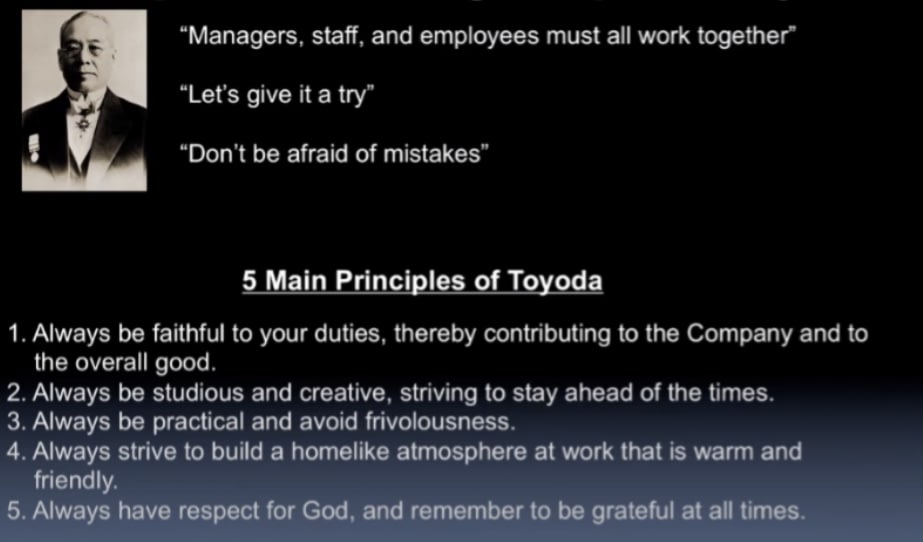
Replace the word “God” with ecosystem and the message still holds:
Respect for the system that sustains you is not optional—it’s foundational.
This ethos, in my view, is what midsized plants need now more than ever:
- A grounded sense of what to sustain
- A disciplined method for how to sustain it
- And a leadership culture that knows who makes it possible
More Related Workforce Articles
- Workforce Development Grants and Funding Opportunities for Manufacturers
- Manufacturing Leadership That Transforms: Building True Followership
- Evidence-Based Leadership Strategies for Manufacturing Excellence (Part 2): Advanced Strategies and Implementation Excellence
- Why Neurodiverse Hiring Is a Competitive Advantage for Manufacturers
- Navigating the Labor Shortage: Solutions for Manufacturers
- Unlock Free Cash: Top Manufacturing Grants You Can’t Ignore in 2025
The Mid-Market Squeeze: What’s Really Going On
At the core of today’s crisis is a chronic imbalance:
Not enough money, time, or resources—combined with relentless pressure to compete.
This leads to a low-tolerance, high-frugality culture: risk-averse, under-invested in people, and reluctant to cross departmental lines. Conversations stay surface-level. Silos remain intact. Functional gaps widen.
And so, dysfunction becomes normalized:
- Collaboration is seen as “extra,” not essential.
- Processes lag or never get built.
- Leaders burn out.
Eventually, the endgame becomes survival—or sale.
That’s the quiet tragedy of the mid-market. The real risk is buried in the details, and it’s often not seen until it’s too late.
What Happens Next Depends on What You Build Now
Robert Sher’s book Mighty Midsized Companies calls out these silent growth killers clearly. But the bottom line is this:
Get aligned now, or get composted.
With AI reshaping how we work, and environmental strain increasing, leaders need to design for resilience now—in real time, not as a future project.
That starts with developing people who can lead, adapt, and improve together.
It’s not just about onboarding or compliance training. It’s about creating a shared map for how your organization works—and how people at every level contribute to making it better.
From Paperwork to Performance: What’s Missing in Most Onboarding Programs
There is a better way. You can structure your business for performance, grow your people, and still maintain the integrity of your legacy.
Let’s start with onboarding.
I’ll never forget reading an article on onboarding in ISPI’s printed magazine during my back in grad school. It changed how I thought about onboarding and learning in facilities that do “hands-on” work.
Most onboarding programs are still built around checklists: policies, SOPs, and HR forms. You sign off on documents, maybe shadow someone for a shift, and then get dropped into the work. But none of that helps new employees understand how the business actually works.
What’s missing is this: A clear, shared understanding of:
- A clear, dynamic understanding of how value flows from raw materials to finished product
- Clarity on how each role fits into the system
- Insight into how departments depend on each other
In many small and midsized manufacturers, even if processes are documented, it’s for compliance—not performance, which leads to results.
That’s where onboarding needs a strategic upgrade.
Define the Process Before You Teach It
The first step is defining the process clearly. One of the best ways to do this is through Task Analysis—a straightforward, repeatable method to break work down into its essential steps.
We use a simple worksheet to map the steps for each job function. It’s not just paperwork—it’s a tool for building shared understanding. Ideally, your on-the-job trainers and subject-matter experts learn how to do task analysis themselves. That’s how you create a culture of internal capability and ownership.
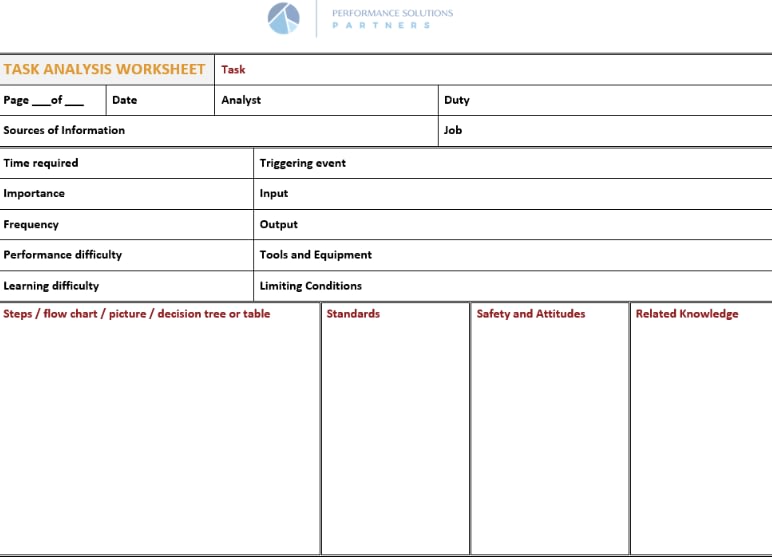
From there, we group tasks into process phases that mirror how work actually happens. Here’s a basic example I’ve used from my early ISPI days—a process chart for producing “dirt cakes” (yes, those dirt cakes!):
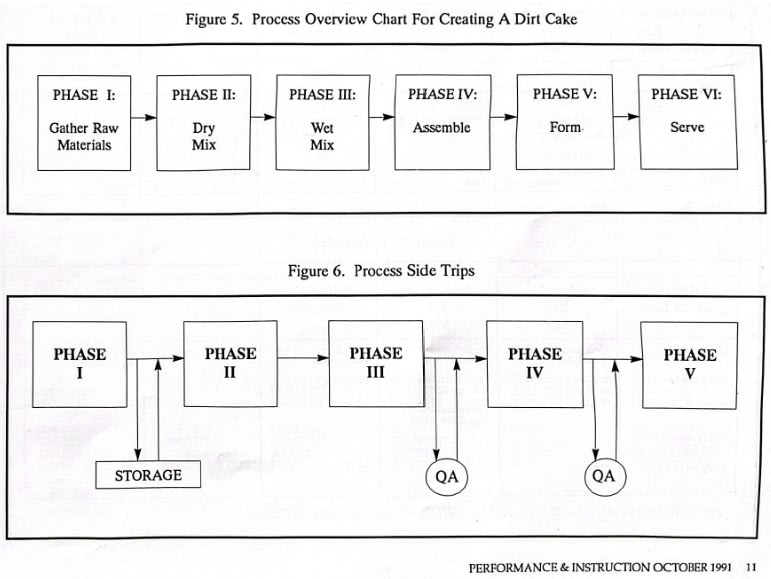
Here’s the shift:
- Stop organizing processes only for Quality audits alone
- Start organizing for clarity, learning, and alignment
- Involve cross-functional teams to agree on task breakdowns and handoffs
- Document what matters—and keep it alive
- Give every employee a shared map of how work gets done
Process Learning as a Keystone for Time-to-Competence
Now let’s connect this to the bigger business picture.
Large corporations track time-to-competence because they know that faster ramp-up times mean faster productivity. Smaller companies often skip this metric—but they shouldn’t. One of the best ways to accelerate learning is by offering a Business Process Overview Course as part of onboarding. It gives new employees context, reduces confusion, and builds confidence from day one.
If you’ve read The Great Game of Business, you know that Jack Stack emphasizes teaching employees how their work connects to financial outcomes. We use the term line-of-sight metrics—meaning employees can see how their daily actions affect cost, throughput and profitability. That insight changes behavior.
But you can’t get there if new employees are overwhelmed on day one.
Without context, you’re asking them to memorize isolated tasks, facts, and safety rules. That’s cognitive overload—a real barrier in adult learning. Add first-week anxiety to that, and it’s no wonder people check out or get labeled as “not getting it.”
I call BS on that.
When onboarding is designed around how people learn, they do get it—and fast.
A Smarter Sequence for Onboarding
Here’s a better structure we recommend for new hire onboarding:
- Company Orientation
- Business Process Orientation
- Process Overview Course
- Structured On-the-Job Training (OJT)
This sequence gives new employees the Big Picture first, helping them understand how they fit in and how they create value—before diving into task-level details.
It also dramatically improves communication across departments. For example, when Product Development talks about a “scale-up,” a new Production worker understands what that means—and why it matters. That’s how you reduce handoff errors and build shared language across the organization.
The Result? A Stronger, Smarter Culture
When onboarding focuses on systems, not just rules, you get:
- Better teamwork
- Fewer mistakes
- Faster time-to-competence
- And a Respect for People culture that sticks
This is how you move from compliance-based onboarding to performance-based onboarding—and from burnout to alignment.
Building the Bridge: From Overview to On-the-Job Training
Let’s get one thing straight:
Training is not a “nice-to-have.” It’s a core part of your operations.
The Process Overview Course is what connects the dots between abstract orientation and hands-on work. When it’s paired with Structured On-the-Job Training (SOJT) and skilled internal instructors, you unlock serious results:
- Reduce training time by 30–50%
- Standardize core work
- Build internal teaching capacity across roles
- Include perspective where work happens
- Develop a reliable mechanism for skill transfer
- Develop shared understanding of how core processes really function
It also is the backbone for your Lean Daily Management (LDM) system, reinforcing:
- What “good” looks like
- How teams can solve problems together
- Why every role matters
And here’s the real payoff:
When someone leaves, the system keeps going. That’s what resilience looks like. That’s what legacy looks like.
Enabling Conditions: What It Takes to Do This Well
Yes, this takes effort. But it’s entirely doable—and absolutely worth it.
When it’s implemented with intention, the impact is lasting. Here’s what that looks like:
- Host small team working sessions to map out key processes, define ownership, identify performance-critical steps and standards. Iterate until you have “good enough.”
- Walk the line, talk the line. Connect classroom content with real work. Blend learning with floor experience and develop your in-house trainers.
- Build process-based learning materials: visual work aids, just-in-time coaching tools, and simple job aids that reinforce standard work.
- Designate and develop part-time learning and performance support roles within your team: facilitators, trainers, technical writers, and process experts.
- Co-develop content with experienced employees who do the work and know the nuance.
You can’t wing this. But you don’t have to go it alone.
Outcomes We See in the Field
- Faster ramp-up times.
- Better peer coaching and culture of accountability.
- More engaged teams in improvement efforts.
- Lower turnover and higher internal promotion.
- A Respect for People culture that reduces stress and builds clarity.
This isn’t theory. These are outcomes we see again and again.
A Strategic Investment for a Changing World
Too often, onboarding gets treated like a checkbox.
But in today’s world—where turnover is high, systems are fragile, and AI is changing the pace—smart plants are investing in people from day one. That means building process thinkers, not just task followers.
Finding Funding for Training and Leadership Development
Good news – there is funding available for training!
Plant leaders who invest in onboarding, process training, and people leadership create more resilient operations and stronger internal pipelines.
These programs in the Great Lakes area, offer reimbursement or direct funding in the for:
- Designing and delivering structured onboarding
- Creating process-based SOJT systems
- Coaching supervisors and developing new leaders
-
State Manufacturing Training Grants
Ohio, Illinois, Wisconsin, Indiana – Local incumbent worker and customized training funds remain active through workforce systems and economic development agencies.
State-funded internal training grant programs in Illinois, Indiana, Wisconsin, and Ohio that are focused on incumbent worker training or employer grants that support onboarding, SOJT, leadership development, and other internal workforce upskilling.
|
State |
Program Name |
Training Reimbursement Details |
Contact Info & Notes |
Source |
|
Illinois |
Illinois WIOA Incumbent Worker Training (via local boards like DuPage, Will County, etc.) |
Up to 100% reimbursement per incumbent worker for certified job training; no firm cap state‑wide but local boards often cap at ~$25K-$50K per employer |
Example: DuPage County workNet: up to $25,000. Contact Business Services Liaisons John Hall / Jack Guldenbecker at Joliet Will County office: (815) 727‑4444. |
|
|
Indiana |
Employer Training Grant (ETG) |
Up to $5,000 per employee, max $50,000 per employer; must be ≥40 hrs occupational training leading to credential or wage gain |
State-run via Indiana DWD. Contact your region’s ETG liaison (find via ETG Contact Map on IN.gov or RHIhub page) |
Indiana Government, Indiana Government, Rural Health Information Hub |
|
Wisconsin |
Wisconsin Fast Forward Worker Training Grants |
Grants range from $5K to $400K, 50% match required. Funds occupational training for incumbent or underemployed workers. |
State DWD administers. Recent award: $1.7M distributed to 14 employers. Contact WI DWD Office of Skills Development, (608) 266‑3131. |
|
|
Ohio |
JobsOhio Workforce Grant |
Covers training tied to job creation or retention; may support leadership, onboarding and technical training—amount varies by project. |
Managed through JobsOhio; contact central office at Columbus (614) 224‑6446 or 1‑855 874‑2530. |
Michigan — Going PRO Talent Fund
This fund:
- Reimburses employers for short-term, job-specific, and leadership training
- Can cover training costs for frontline, mid-level, and future leaders
- Emphasizes retention, promotion, and wage gain as outcomes
Employers can use external training providers, like Performance Solutions Partners, if:
- The training is short-term, customized, and leads to a measurable skill gain
- The provider delivers training not otherwise available internally
- The training is tied to retention, promotion, or wage gain
- The provider is included in the application as the training vendor
Check out: michigan.gov/talentfund
-
Department of Energy (DOE) IAC / ITAC (Industrial Training and Assessment Center) Implementation Grants
Designed for manufacturers implementing process improvements and performance-based systems.
- Covers related training such as standard work, leadership for lean/CI, and OJT
- Strong fit if you’re linking process and leadership development
- This is the current federal program offering grants up to $300,000 per manufacturer, reimbursing 50% of eligible project costs. It supports implementation of recommendations from ITAC, CHP-TAP, or DOE-qualified equivalent assessments:
- Improves productivity, energy/material efficiency, and reduces waste/emissions
- Project eligibility for SMMs (under 500 employees, <$100M annual revenue, energy bill $100K–$3.5M)
- Rolling applications reviewed quarterly
luiac.cc.lehigh.edu+12The Department of Energy’s Energy.gov+12energywerx.org+12energywerx.org
- Reach out to the Market Outreach Specialists CLEAResult, on behalf of Nicor Gas. DM me for contact information.
-
SBA Technical Assistance & Training Network
- SBA continues to provide non-grant support through organizations such as:
- Small Business Development Centers (SBDCs)
- SCORE
- Women’s Business Centers
- Red tap hotline to help de-risk for SMBs: https://advocacy.sba.gov/hotline/
- DM me for contact information for the District Director for the Illinois District Office, responsible for promoting small business resources across Illinois including access to capital, counseling and training, government contracting, international exporting, and disaster relief.
-
Local Talent Pipelines
Argonne National Laboratory’s Battery Workforce Challenge Program
- Argonne manages this DOE-led initiative through its STEP (Strategic Transportation Education & Partnerships) division. This program establishes regional workforce training hubs, designed to:
- Reskill and upskill technical and transitional workers in battery and EV manufacturing
- Develop training content in collaboration with local colleges and industry partners (e.g. University of Michigan–Dearborn, Henry Ford College)
- Support clean energy job growth with $23M+ funding to train thousands of workers across the U.S.
- Educational partnerships in equity-driven STEM access programs, such as “Bridge into Internships” for high school students
- DM me for local contact information.
Ready to Strengthen Your Onboarding Program?
If your onboarding still looks like it did 10 years ago, it’s time for an urgent update.
Here’s how we can help at Performance Solutions Partners :
- Assess your current onboarding and training system
- Identify performance and process gaps
- Design a fit-for-purpose approach that links onboarding, operations, and leadership development
Let’s make onboarding a driver of excellence—not an afterthought.
What Sized Companies Like to Partner With Us
At Performance Solutions Partners , we partner with mid-sized employers — often in crisis or transition — to stabilize operations, heal culture, and re-architect work itself. Our clients are stuck in patterns of burnout, turnover, and fragmentation. We help them become companies people want to stay with, grow in, and believe in. We do that through structural redesign involving the people who do the work to improve, reduce dysfunction, and ignite keys to culture where legacy can prosper.


