Introduction

Today, AI workforce integration has evolved from a conceptual phase to a practical, measurable advantage, as evidenced by its implementation in factories worldwide which have seen the use of AI-driven predictive maintenance systems reduce downtime by 30%.
In 2025, manufacturers haven’t been simply investigating AI tools, they’ve been investing in and implementing them alongside existing workforce teams. Their intent is to improve analysis and judgment by pulling large amounts of data into AI that can reach conclusions in seconds. Thus, expanding on worker capability by offering troubleshooting and process instructions on demand, and strengthening operational performance and results by providing real-time feedback.
This approach is driven by the cost pressures affecting all levels and disciplines of manufacturing. Manufacturers are dealing with skills gaps, an aging workforce, increased quality and safety demands, and the need to produce more with fewer people. If they don’t adapt and generate consistent profits, they cannot stay in business. Therefore, AI augmented manufacturing has become a “must-have” in frontline worker reskilling efforts.
According to Deloitte’s 2025 Smart Manufacturing Survey, 29% of manufacturers have already deployed AI or machine learning at the factory level, and another 42% expect to expand its use within a year. Meanwhile, the adoption of generative AI rose to 24% in 2025 which demonstrates significant acceleration of implementation. These numbers reflect a clear effort to retain employees while helping increase their efficient output in both quantity and quality.
The ultimate objective of training the workforce for AI is necessary for manufacturers to stay ahead of customer demands profitably.
This article explores some of the top strategies manufacturers employ for successful AI workforce integration into their companies by including AI-assisted training and predictive maintenance, among other employee’s support tools. We are sharing real case studies, using valid sources, and generating practical takeaways. The key to success is providing support to leaders responsible for technology, operations, and workforce development. Artificial Intelligence is created to support human development and execution, not to replace it.
Overview of Key Points
- AI is strengthening, not replacing, workforce talent
…as demonstrated by a 20% increase in productivity in factories where AI tools assist workers in decision-making processes. The highest value use cases focus on guiding reliable operator decisions and reducing physical and mental decision-making strain.
- Training and upskilling remain central
Companies that invest in increasing the skills of their workforce while supplementing them with AI support see stronger AI implementation and less resistance from workers.
- AI copilots and agents have become mainstream tools
Industrial copilots now support maintenance, planning, quality assurance, scheduling, as well as operator decision-making. Shop floor leadership is learning how to effectively integrate AI skills for manufacturing teams.
- Cobots + AI vision systems are scaling
Manufacturers connect collaborative robots with human “supervisors” to achieve predictable throughput and safe, consistent output. Worker interaction with automated operations is still a fairly new experience that created the demand for continuing training at all levels of manufacturing management, as well as for factory floor workers.
- Predictive maintenance is creating additional technician time availability
AI-enabled diagnostic systems reduce troubleshooting work and allow technicians to focus on corrective and preemptive actions. Applying this technology to legacy equipment remains a challenge for ROI evaluation. The decision to invest in new equipment or upgrade the old to increase efficiency is often felt as a risky decision by upper management. Having a workforce prepared for AI predictive maintenance roles helps them move forward with confidence.
Boosting Productivity and Profits: 5 AI Workforce Integration Strategies for Manufacturers

- AI-Assisted Skills Upgrading and On-the-Job Training
The largest barrier to a factory’s success without AI implementation is not a technology issue, it is the challenge of transferring skills from experienced tradesmen to their replacement crews. Long-tenured specialists are hard to replace because they typically have knowledge stored in their head from years of experience more than they have recorded documents.
If advance planning has not been done by companies, baby-boomer retirements become devastating. Many manufacturers have failed to allow enough time for mentoring the upcoming workforce and need to quickly tie into resources to implement AI training and record technical information via video and written documentation in the short-term.
More Workforce & Funding Insights
- Workforce Development Grants and Funding Opportunities for Manufacturers
- Navigating the Labor Shortage: Creative Solutions for Manufacturers
- Don’t Just Onboard—Build Capacity: The Process-Based Approach to Resilience and Results in Manufacturing
- Fast Business Loans for Manufacturers: Same-Day Top 5 in 2025
- From Dusty Floor to Leadership Door: Your Guide to Unlocking Hidden Talent in Manufacturing
AI-powered learning tools accelerate proficiency by offering targeted learning outlines, guided practice, and real-time troubleshooting support precisely when employees need it. When triggered by events such as abnormal machine readings, setup deviations, or recurring error patterns, instructions are delivered directly to the operators who can immediately apply corrective actions with higher accuracy.
Here’s How It Works
- Micro-learning engines deliver short, personalized training content based on job role, recent errors, or machine usage patterns.
- Just-in-time learning: Provides instant access to specific information which is critical for preventing mistakes, especially with complex tasks or safety-sensitive operations.
- Improved knowledge retention. Sessions are delivered in small bites so that there is ability to digest the information before moving on making it easier to retain over time.
- Personalized training: Allows employees to focus on areas where they need improvement. They have the ability to skip sessions they have already mastered or repeat those where a refresher is needed.
- Enhanced efficiency. Continuous training as problems occur or questions arise allows for quick application of solutions. This also reduces time away from work for traditional, lengthy training programs which reduces cost and makes learning more efficient and available.
- Real-time troubleshooting
- Machines detect issues instantly, often before the operator notices
- Modern equipment is packed with sensors that constantly monitor key parameters and provides warning messages, data feedback, and points out locations to find the issue.
- Instead of the operator having to figure out the root cause, the machine flags the issue immediately
- Example:
• An assembly machine detects rising force outside the specified requirement.
• Equipment display provides step-by-step instructions developed to resolve the issue - Identify the specific fault with a photo showing were to find the issue
- Displays the likely causes
- This is like having a digital coach built into every workstation.
- Machines detect issues instantly, often before the operator notices
Workforce Benefits
- Faster time to proficiency for new hires or cross-training workers
- More consistent performance and communication with retained historical data
- Increased confidence and engagement due to clear direction and support
- Reduced dependence on a small group of experts
Case Study: BMW + NVIDIA DGX Synthetic Data Training
BMW Group dramatically increased the speed and scale of its AI model training using NVIDIA DGX system and synthetic data pipelines. Their dataset, SORDI (Synthetic Object Recognition Dataset for Industry), includes more than 800,000 synthetic images, enabling frontline teams to train quality-inspection models without the manual burden of collecting real images or hand-labeling data. BMW reports up to 8x improvement in data-science productivity when using NVIDIA’s DGX infrastructure.
Source: https://www.nvidia.com/en-us/case-studies/bmw-optimizes-production-with-ai-and-dgx-systems/
Training Impact: Operators now receive improved vision-based inspection support, reducing cognitive workload required for real-time checks.
- AI-Enhanced Factory Workflows and Decision Support
Shop floor operators are often overwhelmed with multiple tasks as part of the production process. AI workforce integration utilizing copilots and agents simplifies the environment by providing real-time recommendations and actionable insights.
Here Is How It Works
- AI agents scan sensor, ERP, MES, and machine data to suggest the next best action.
- AI copilots continuously monitor the process and analyze vast amounts of data in seconds what would take an operator minutes of non-productive time to review. Then the copilot provides insights, guides decision-making, or performs actions automatically, as needed.
Workforce Benefits
- Higher % first-time repair rates and reduced scrap
- Reduced mental decision-making load
- More predictable production outcomes
- Better scheduling and sequencing
- Stronger alignment between operators and supervisors with supported data.
Case Study: Siemens Industrial AI Agents
Siemens introduced Industrial AI Agents capable of autonomously executing planning, engineering, operations, and maintenance workflows. Within the Industrial Copilot ecosystem, these agents perform cross-functional tasks — while humans retain control, oversight, and approval authority.
- Siemens estimates up to 50% productivity gains for some workflows using AI agents.
Source: https://press.siemens.com/global/en/pressrelease/siemens-introduces-ai-agents-industrial-automation
In 2025, this ecosystem included Operations Copilot, allowing workers to query machine conditions through natural language and receive instant diagnostic recommendations.

- Collaborative Robotics (Cobots) + Human-in-the-Loop (HITL) AI
Cobots are designed to work safely alongside workers and fill labor gaps when tasks are repetitive or precision-dependent. Rather than replacing humans, cobots provide consistency and safety while the workforce provides oversight and handles exceptions.
How It Works
- Cobots handle repetitive tasks such as machine loading & unloading, fastening, welding, packaging, and many other duties.
- AI vision systems detect defects or guide cobot movements based on the environment or components requiring manipulation.
- Human “supervisors” provide training or programming, feedback, and validation to confirm results are achieved at the standards established.
Workforce Benefits
- Reduced repetitive physical strain injuries
- Predictable machine cycle times
- Higher quality consistency
- Workers shift into higher-skill roles such as programming, and process optimization.
Case Study: BMW AI-Enabled Logistics Robots
In BMW’s logistics operations, AI-enabled autonomous robots trained using NVIDIA Isaac simulation are deployed to move materials through complex environments.
- Simulation + synthetic data improved navigation performance
- Workers are redeployed to coordination, exception management, and continuous improvement roles
Source: https://www.iotm2mcouncil.org/iot-library/news/smart-logistics-news/nvidia-improves-bmw-logistics-with-ai-robots/
BMW’s hybrid “robot + human” workflow creates safer, more stable logistics processes without eliminating human roles.
- Predictive Maintenance and Smarter Workforce Scheduling

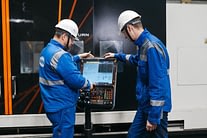
Unplanned downtime remains one of the biggest drivers of lost output. Traditional maintenance models rely heavily on manual monitoring or calendar-based intervals. AI elevates maintenance by predicting possible failures and recommending technician schedules based on real-time equipment condition and hours of usage, historical results, availability of parts, and worker skill profiles.
Here is How It Works
- Machine Learning models pull various data types such as vibration, thermography, torque, and cycle data.
- AI diagnostic agents identify root causes and recommend specific corrective or maintenance actions.
- Maintenance copilots suggest ERP work orders based on technician capability and workload, urgency, and machine loads.
Workforce Benefits
- Less time handling emergencies
- Better-timed, pre-planned repairs
- Improved on-time delivery performance
- Reduced overtime and burnout
Case Study: Siemens Maintenance Copilot (Senseye)
Siemens’ Maintenance Copilot, integrated with Senseye Predictive Maintenance, analyzes machine data and recommends targeted interventions.
- Siemens reports maintenance teams can reduce reactive activity by 25% or more.
Source: https://press.siemens.com/global/en/pressrelease/siemens-introduces-ai-agents-industrial-automation
Maintenance staff report fewer emergency call-ins and more meaningful, high-skill work.
- Organizational Change: Workforce Development-Driven AI Strategy
Technology alone does not create workforce transformation, leadership and employee experience does. Best-in-class companies structure AI integration around a strategic and primary focus on developing the people who will interact with and manage the technology. This focus includes reskilling, communication, testing standards, and ethical use policies.
Driven Workforce offers a free resource “3-steps to help manufacturing leaders meet production schedules profitably“ in support of workforce development
Core Elements of AI Workforce Integration and Development
- Defined decision-making authority for when and how AI tools are used
- Reskilling programs that align career paths with company objectives
- Metrics linking employee experience as well as outputs or overall results
- Change management plans that include communication, training, and alignment to company culture
- Oversight rules ensuring workers supervise AI systems
Workforce Benefits
- Lower resistance to AI adoption
- Better employee retention and engagement
- Improved collaboration across departments
- Greatly improved efficiency and customer service
Case Study: Bosch’s Large-Scale Workforce AI Training Initiative
Bosch has invested heavily in upskilling programs designed to prepare workers for AI-enabled roles.
- Bosch trained 130,000+ employees in future technologies through its LernWerk programs.
- Bosch’s 2025 Tech Day highlighted agentic AI systems used to optimize schedules, predict maintenance, and support quality.
Sources:
https://www.bosch-presse.de/pressportal/de/en/training-campaign-bosch-trains-over-130000-associates-in-technologies-of-the-future-258176.html
https://us.bosch-press.com/pressportal/us/en/press-release-27776.html
Bosch’s approach demonstrates that AI implementation succeeds when workers are equipped to partner with technology.
Table: AI Workforce Integration Impact (2024–2025 Benchmarks)
| Workforce Area | Traditional Model | AI-Integrated Model | Measurable Impact |
| Training & Onboarding | Manual, slow, expert-dependent | AI microlearning + AR/VR | 30–40% faster proficiency (Deloitte 2025) |
| Operator Decision-Making | Experience-based | AI copilots + insights | Up to 50% faster decisions (Siemens) |
| Quality Inspection | Manual checks | AI vision + synthetic data | 66% reduction in model training time (BMW/NVIDA) |
| Maintenance | Reactive | Predictive + AI diagnostic agents | 25% reduction in reactive work (Siemens) |
| Logistics | Manual flow | Autonomous robots + human oversight | Higher throughput (BMW) |
Caption: AI workforce integration improves efficiency across training, decision-making, quality, maintenance, and logistics.
Conclusion: AI + People = The Winning Formula for 2025–2026
Across all examples in this article, one pattern stands out: manufacturers win when AI enhances workers, not when it replaces them. Companies that see the strongest returns such as BMW, Siemens, Bosch, and others, are those that treat AI workforce integration as both a useful technology and a people growth strategy.
In 2025–2026, AI will continue evolving toward agentic automation and deeper MES/ERP integration. But human-centered leadership will remain the determining factor.
For leaders responsible for building the manufacturing workforce of the future, the path is clear: pair strong AI capability with equally strong development opportunities for people. Organizations that follow this model will not only keep their workforce engaged, they will outperform competitors on productivity, quality, and operational excellence.
Ready to Strengthen Your Leadership Impact?
If you’re looking to improve how your team handles daily challenges and consistently meet production schedules profitably, download the Driven Workforce free resource: 3 Steps to Meet Production Schedules Profitably. It’s a practical guide drawn from real-world manufacturing experience that will help you streamline communication, engage your workforce, and turn daily problems into performance gains.
Sources & Further Reading
- Deloitte — 2025 Smart Manufacturing and Operations Survey
https://www.deloitte.com/us/en/insights/industry/manufacturing/2025-smart-manufacturing-survey.html - McKinsey — Superagency in the Workplace: Empowering People to Unlock AI’s Potential
https://www.mckinsey.com/capabilities/mckinsey-digital/our-insights/superagency-in-the-workplace-empowering-people-to-unlock-ais-full-potential-at-work - NVIDIA + BMW Synthetic Data Case Study
https://www.nvidia.com/en-us/case-studies/bmw-optimizes-production-with-ai-and-dgx-systems/ - Siemens — Industrial AI Agents for Industrial Automation
https://press.siemens.com/global/en/pressrelease/siemens-introduces-ai-agents-industrial-automation - Bosch — Training Campaign for Future Technologies (130,000+ employees)
https://www.bosch-presse.de/pressportal/de/en/training-campaign-bosch-trains-over-130000-associates-in-technologies-of-the-future-258176.html - Bosch Tech Day — Agentic AI in Manufacturing
https://us.bosch-press.com/pressportal/us/en/press-release-27776.html - BMW Logistics Robots (AI + Simulation)
https://www.iotm2mcouncil.org/iot-library/news/smart-logistics-news/nvidia-improves-bmw-logistics-with-ai-robots/
Author Bio

Founder/President
Driven Workforce
With over 40 years’ experience in manufacturing, I’ve worked at all levels, from the shop floor to executive. I’ve led teams, built factories, and coached hundreds of employees — turning my real-world experience into proven management insight.